Driving Roller
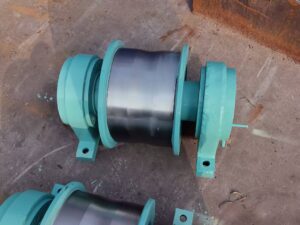
The driving roller, as a crucial core component for power transmission and material transportation in various types of industrial equipment, is widely used in metallurgy, mining, papermaking, printing, conveying machinery, steel rolling production lines, and other fields. By rotating itself, it directly drives the accompanying conveyor belt, rolled materials, or other transmission components to operate. It is a fundamental component that ensures the continuous, stable, and efficient operation of equipment.
I. Core Working Principle
The primary function of the driving roller is to convert the torque from the power source (motors, gearboxes, etc.) into the kinetic energy required for the movement of the material or the conveyor belt. In practical applications, one end of the driving roller is connected to the power system. When the power source outputs torque, the driving roller rotates accordingly, utilizing the frictional force (or meshing transmission) between itself and the contacting components to synchronously move the conveyed material or linked components, thereby enabling the transportation of materials and the rolling of components in industrial processes.
II. Key Features and Material Selection
The performance of the drive roller directly affects the operational efficiency and stability of the entire equipment. Therefore, its material and design must be suitable for various operating conditions.
Material classification and application scenarios.
Carbon Steel/Alloy Forged Steel Drive Roll: Characterized by high strength and toughness, it can withstand significant loads and impacts. It is commonly used in heavy-duty applications such as metallurgical rolling production lines and heavy-duty conveying equipment.
Stainless Steel Drive Roll: Extremely corrosion-resistant, with a highly polished surface. Suitable for use in food processing, pharmaceutical manufacturing, and chemical industries, where high standards of hygiene and corrosion resistance are required.
Rubber-coated drive rollers: A wear-resistant rubber layer is applied to the surface of metal roll cores, which can effectively increase friction, prevent slipping, and reduce wear on the conveyed materials. These rollers are widely used in belt conveyors, paper-making machinery, and other equipment.
Ceramic Coating Drive Roll: By applying a ceramic coating, the surface hardness and wear resistance are enhanced, and the material’s ability to withstand high temperatures and oxidation is improved. This is suitable for harsh industrial environments with high temperatures and wear.
Core feature requirements.
High wear resistance: reduces surface wear during prolonged operation, extending the lifespan and lowering maintenance costs for the equipment.
Precise dimensional accuracy: ensures smooth integration with other components of the equipment, preventing operational oscillations or failures caused by eccentricity or dimensional deviations.
Excellent load-bearing capacity: capable of handling load variations under various operating conditions with stability, ensuring the reliability of equipment operation.
III. Typical application areas
Metallurgical industry: In steel rolling production lines, the drive roll is a critical component for transporting and positioning the rolled products. It works in conjunction with the rollers to perform the rolling and transmission of steel. It must possess characteristics such as high-temperature resistance, wear resistance, and strong load-bearing capacity.
In the field of conveying machinery, the core power components of belt conveyors and roller conveyors drive the movement of the conveyor belt through the rotation of the driving rollers, enabling the long-distance transportation of various materials such as sand, coal, and grain.
Paper and printing industry: Used for the transportation, positioning, and traction of paper. High demands are placed on the smoothness of the roller surfaces and the stability of rotation to prevent scratching the paper or affecting printing precision.
Mining and Construction Materials Industry: In the process of crushing ore and transporting construction materials, drive rollers must endure heavy loads and high wear conditions. High-strength alloy materials or wear-resistant coatings are commonly used to handle these situations.
IV. Quality Assurance and Maintenance Key Points
High-quality drive rollers undergo rigorous production inspections, involving processes such as material composition analysis, dimensional accuracy testing, dynamic balancing tests, and hardness testing. These steps ensure that the product meets performance standards. In daily use, drive rollers should be regularly cleaned and lubricated, and the surface wear and the tightness of the connection points should be inspected. This can effectively extend their lifespan and ensure the stable operation of the equipment.