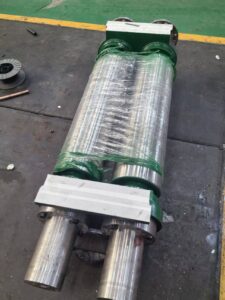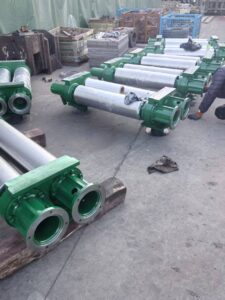
wrapper roll
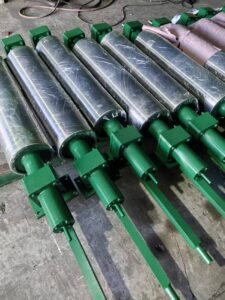
As a core supporting component in industries such as metallurgical rolling and coil processing, the wrapper roll (also known as coiler roll) is mainly used to cooperate with coilers to achieve stable and tight winding of metal coils such as steel strips and aluminum strips. Its manufacturing precision and material performance directly determine the forming quality and production efficiency of coils. This product strictly complies with industrial-grade standards, is crafted through multiple precision processes, and integrates high strength, wear resistance and fatigue resistance, being adaptable to complex working conditions such as hot rolling and cold rolling.
I. Core Product Positioning and Application Scenarios
This wrapper roll is specially designed for coiler systems. Its core function is to guide metal strips to wind smoothly onto the coiling shaft through precise pressure adjustment and speed matching at the end of coil production, while suppressing wrinkling and looseness of coils to ensure the roundness and tightness of steel/aluminum coils. It is widely applied in scenarios such as hot-rolled steel strip production lines, cold-rolled sheet processing lines, and non-ferrous metal coil production lines, capable of adapting to the processing needs of metal strips of different widths and thicknesses, and compatible with high-speed, heavy-load continuous production conditions.
II. Core Production Process
(I) Raw Material Selection and Pretreatment
Raw material quality is the foundation of the wrapper roll’s durability. This product adopts high-quality alloy structural steel (such as 42CrMo) or wear-resistant alloy steel as the base material. Such materials possess high strength, high toughness and excellent fatigue resistance, able to withstand repeated impacts and friction during the coiling process. Before warehousing, raw materials undergo strict flaw detection and component analysis to eliminate defects such as inclusions and cracks; subsequently, heat treatment processes such as normalizing and tempering are carried out to eliminate internal stress of the material, improve the stability of the base material, and lay a foundation for subsequent processing.
(II) Precision Machining
1. Rough Machining Stage: Large CNC lathes are used for turning the base material to initially form the roll contour and shaft head structure, with a reasonable finishing allowance reserved. During this stage, the coaxiality and roundness of the roll must be strictly controlled to avoid subsequent assembly problems caused by machining deviations.
2. Finishing Stage: High-precision CNC grinders are used for grinding, controlling the surface roughness of the roll below Ra0.8μm and the dimensional accuracy error within ±0.02mm, to ensure the roll surface is smooth and flat, with uniform force when in contact with coils. Meanwhile, milling and drilling are performed on the shaft head to ensure precise matching with transmission components and bearings, improving transmission efficiency.
3. Detail Processing: Chamfering and deburring are carried out on the roll edges to avoid scratching the metal strip by sharp edges; quenching treatment is applied to the matching surface of the shaft head to improve surface hardness and enhance wear resistance.
(III) Surface Strengthening Treatment
To cope with severe friction and high-temperature wear during coiling, the roll surface needs professional strengthening treatment. This product adopts plasma spray welding or laser cladding technology to deposit a wear-resistant alloy layer (such as WC-Co alloy) on the roll surface. This alloy layer has extremely high hardness (HRC≥60) and wear resistance, which can effectively extend the service life of the wrapper roll—3 to 5 times longer than that of ordinary heat-treated rolls. After spray welding/cladding, grinding and finishing are performed again to ensure the surface precision and flatness of the roll are not affected.
(IV) Assembly and Commissioning
The processed roll is precisely assembled with accessories such as bearings, seals and connectors. Special tools are used during assembly to control the fit clearance, avoiding loosening and jamming. After assembly, static debugging and dynamic trial operation are conducted to test the rotation flexibility, coaxiality and sealing performance of the roll, ensuring no abnormal noise, leakage and other issues; meanwhile, pressure tests are carried out under simulated actual working conditions to verify the stability of the wrapper roll under rated load.
(V) Finished Product Inspection and Delivery
Finished products undergo multi-dimensional strict inspections, including dimensional accuracy re-inspection, surface hardness testing, flaw detection (ultrasonic and magnetic particle inspection), dynamic balance testing, etc., to comprehensively identify machining defects and assembly problems, ensuring the products meet industry standards and customer requirements. Qualified products undergo anti-rust treatment and packaging, accompanied by product qualification certificates and inspection reports, before leaving the factory for delivery.
III. Core Product Advantages
1. Excellent Material: Selected wear-resistant alloy steel base material and WC-Co wear-resistant layer, integrating high strength and wear resistance to adapt to complex working conditions.
2. Controllable Precision: Full-process machining with high-precision CNC equipment, featuring small dimensional error and smooth surface, ensuring coil forming quality.
3. Long Service Life: Supported by surface strengthening treatment, its service life is much longer than that of ordinary wrapper rolls, reducing equipment operation and maintenance costs.
4. Wide Adaptability: Customizable roll size and surface process according to customer needs, adapting to coilers and coil processing scenarios of different specifications.
IV. Quality Control System
The company has established a full-process quality control system. Special personnel are assigned to conduct inspection and recording at each link from raw material warehousing, processing to finished product delivery, and advanced testing equipment is adopted to ensure inspection precision. Meanwhile, it complies with the ISO9001 quality management system standard to standardize the production process, ensuring the consistency and reliability of each batch of wrapper roll products, and providing customers with stable and durable core component support.